 By Caleb Morgan
Updated November 2026
If you have sciatica and spend most of your day at a desk, the right ergonomic chair for sciatica can make a noticeable difference in how your lower back and leg feel by the end of the workday. Sciatica usually comes from pressure on the sciatic nerve, often where it runs through the lower spine and buttocks, and sitting for long stretches tends to aggravate it. This list focuses on the features that matter most for that situation: adjustable lumbar support that fills the curve of your lower back, a seat depth you can set so the backrest actually supports you, a seat that does not press hard on the back of the thighs, and a tilt mechanism that lets you shift position without getting up. We compared these picks based on manufacturer specifications, brand track record and patterns that owners commonly describe in their feedback. We did not test these chairs ourselves, and nothing here replaces advice from your doctor or physical therapist.
Our top picks at a glance
- 1
 TOP CHOICEBest overallMarsail Ergonomic Office ChairView on Amazon
- 2
 TOP CHOICEBest for long workdays with adjustable armsErgonomic Mesh Office Chair, Dual Lumbar Support, 330lbsView on Amazon
- 3
 TOP CHOICEBest for a compact home officeBestOffice Ergonomic Office Chair, Mid-Back Swivel Desk ChairView on Amazon
- 4
 Best for adding support to a chair you already ownSeat Cushion for Office Chair, Ergonomic Cushion with Lumbar Support PillowView on Amazon
- 5
 Best for flexible recline and flip-up armsCAPOT Ergonomic Mesh Office Chair, Adjustable Lumbar High Back Desk ChairView on Amazon
Our Top Picks
Quick Comparison
| Product | Best for | Key feature |
|---|---|---|
| Marsail Ergonomic Office Chair | Overall sciatica-friendly support | High mesh back with adjustable lumbar support and 3D armrests |
| Seat Cushion for Office Chair | Adding relief to an existing chair | Memory foam cushion with a built-in lumbar pillow |
| BestOffice Ergonomic Office Chair | Small home offices | Mid-back design with lumbar support and adjustable height |
| Ergonomic Mesh Office Chair (dual lumbar) | Long workdays and varied body sizes | Dual lumbar support with adjustable seat depth and 4-lock tilt |
| CAPOT Ergonomic Mesh Office Chair | Frequent position changes | 4D flip-up arms and 3-level tilt backrest |
Marsail Ergonomic Office Chair
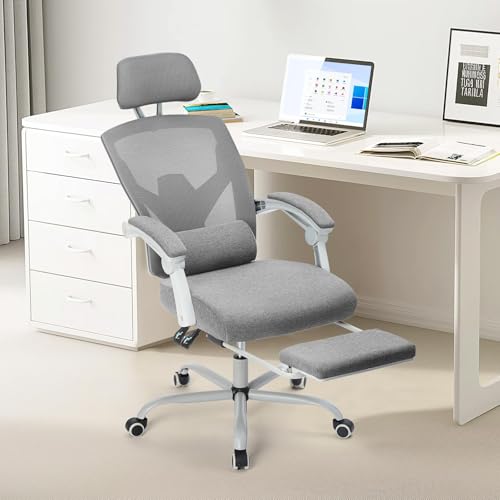
Marsail Ergonomic Office Chair: Office Desk Chair with High Back Mesh and Adjustable Lumbar Support Rolling Work Swivel Task Chairs with Wheel 3D Armrests and Headrest
Best for: Overall sciatica-friendly support at a desk for most of the day.
This is a good starting point for someone who wants a high-back mesh chair with lumbar adjustment and a full set of positioning controls. It suits desk workers who need to change their lower back support throughout the day rather than sit in one fixed shape.
Key specs
- High mesh backrest
- Adjustable lumbar support
- 3D armrests and adjustable headrest
- Swivel base with wheels
Pros
- Adjustable lumbar support helps you match the curve of your lower back.
- Mesh back tends to stay breathable during long sessions.
- 3D armrests let you bring your elbows into a neutral position.
Cons
- Mesh can feel firmer than padded chairs, which some people with sensitive thighs may not prefer.
- Full setup takes several minutes to get right.
Bottom line: Choose this if you want a well-rounded chair with lumbar adjustment and are willing to spend a few minutes dialing it in.
View on AmazonSeat Cushion for Office Chair, Ergonomic Cushion with Lumbar Support Pillow
Seat Cushion for Office Chair, Ergonomic Cushion with Lumbar Support Pillow | Extra Large Memory Foam Cushion for Coccyx , Tailbone & Sciatica Pain Relief, Ideal For Office Chairs, Car Seats, Wheelcha
Best for: Adding relief to an existing chair without replacing it.
This suits people whose current chair is otherwise adequate but puts pressure on the tailbone or lower back. It is designed for the coccyx, tailbone and sciatica-related pressure points, and it can also be moved between a desk chair and a car seat.
Key specs
- Memory foam seat cushion
- Integrated lumbar support pillow
- Designed to reduce pressure on the tailbone
Pros
- Low-cost way to add cushioning to an existing chair.
- Portable enough to move between chairs.
- Helps offload pressure from the tailbone when you sit for long periods.
Cons
- Does not adjust the chair’s geometry, so it cannot fix a seat that is too deep or too high.
- Memory foam can feel warm over long sessions.
Bottom line: A useful add-on if your chair is mostly fine but your tailbone or lower back needs extra padding.
View on AmazonBestOffice Ergonomic Office Chair, Mid-Back Swivel Desk Chair
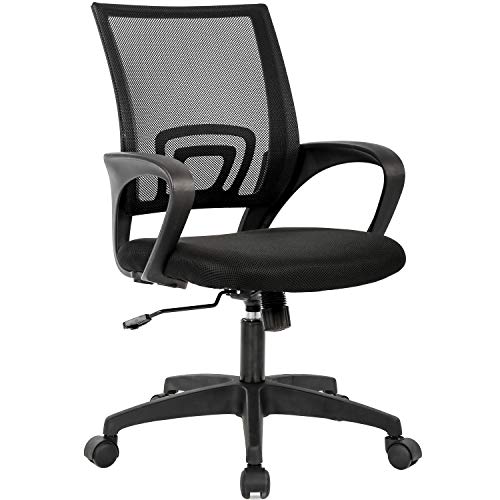
BestOffice Ergonomic Office Chair | Mid-Back Swivel Desk Chair | Dark Black | with Lumbar Support, Adjustable Height & Breathable Backrest | Sponge Seat & Rolling Wheels | for Home, Office | Pack of 1
Best for: Small home offices where space is limited.
A mid-back design keeps the chair’s footprint compact, which helps in tight rooms. It is a sensible choice for someone who wants lumbar support without a large, high-back frame.
Key specs
- Mid-back backrest
- Lumbar support
- Adjustable height
- Sponge seat and rolling wheels
Pros
- Compact profile suits smaller rooms.
- Adjustable height helps match desk level.
- Breathable backrest keeps the back cooler than solid padding.
Cons
- Mid-back design offers less upper back and neck support than high-back chairs.
- Sponge seats can compress over time and may feel less firm after heavy use.
Bottom line: A good fit for a small desk setup if your main need is lumbar support rather than full-back coverage.
View on AmazonErgonomic Mesh Office Chair, Dual Lumbar Support, 330lbs
Ergonomic Mesh Office Chair – 10 Hours Comfort Dual Lumbar Support, 330lbs | 630° Armrests, 3D Headrest, Adjustable Seat Depth, Tilt &4- Lock, BIFMA, 5'3"-6'5" Fit, Home & Office Long Work No Back Pai
Best for: Long workdays and a wider range of body sizes.
The listing states a fit range of 5’3″ to 6’5″ and dual lumbar support, which makes it relevant for people who need precise adjustment across different body heights. Its seat depth and tilt controls are the main reasons it earns a place here for sciatica.
Key specs
- Dual lumbar support
- Adjustable seat depth
- Tilt with 4-lock mechanism
- Armrests and 3D headrest
Pros
- Adjustable seat depth lets you keep your back against the backrest without pressing the back of your thighs.
- Tilt lock lets you recline in a set position rather than sliding forward.
- Stated fit range covers a broad set of heights.
Cons
- Many adjustment points take time to learn.
- Mesh surfaces can feel firm for people who prefer deep padding.
Bottom line: Pick this if you sit for hours and want fine control over seat depth and recline for back and leg comfort.
View on AmazonCAPOT Ergonomic Mesh Office Chair, Adjustable Lumbar High Back Desk Chair
CAPOT Ergonomic Mesh Office Chair, Adjustable Lumbar High Back Desk Chair 400lbs, 4D Flip-up Arms, 3-Level Tilt Backrest, 3D Headrest, PU Wheels, Swivel Rolling Computer Chair for Long Desk Work
Best for: Frequent position changes throughout the workday.
Sciatica often gets worse when you hold one position too long, so a chair that makes it easy to shift is useful. This model’s flip-up arms and multi-level tilt give room to change posture without leaving the desk.
Key specs
- High mesh backrest with adjustable lumbar support
- 4D flip-up armrests
- 3-level tilt backrest
- 3D headrest and PU wheels
Pros
- Flip-up arms make it easier to slide close to the desk or step away.
- Multi-level tilt supports a range of seated positions.
- High back gives support from the lower back up to the shoulders.
Cons
- Many moving parts mean more to adjust and check over time.
- Flip-up arms may not suit people who prefer fixed armrests for support.
Bottom line: A strong choice if you prefer to change position often and want armrests that move out of the way.
View on AmazonBuying Guide
Lumbar Support That Adjusts
Sciatica flares often relate to how your lower back is supported. Look for lumbar support you can raise or lower, and push in or out, so the curve of the chair meets the curve of your spine. Fixed lumbar pads sometimes sit too high or too low for a given frame. Set the lumbar so you feel light, even contact rather than pressure.
Good picks for this: Marsail Ergonomic Office Chair, Ergonomic Mesh Office Chair
Seat Depth
If the seat is too deep, the front edge presses into the back of your thighs and can irritate the sciatic path. Aim for a gap of roughly two to three finger widths between the seat edge and the back of your knees when you sit back against the backrest. An adjustable seat depth makes this easier to set.
Good picks for this: Ergonomic Mesh Office Chair, Marsail Ergonomic Office Chair
Seat Cushioning and Pressure Relief
Very firm seats can increase pressure on the buttocks and tailbone, while very soft seats can let you sink and lose support. Medium firmness with some contouring tends to work for many people. If your current chair is otherwise suitable, a cushion can help redistribute pressure on the tailbone.
Good picks for this: Seat Cushion for Office Chair, BestOffice Ergonomic Office Chair
Recline and Tilt Control
Changing angle reduces the load on any one spot. A tilt mechanism with a lock lets you recline a little, which many people find eases pressure on the lower back. Check that the tilt tension can be adjusted, and that you can lock the backrest at a few different angles.
Good picks for this: CAPOT Ergonomic Mesh Office Chair, Ergonomic Mesh Office Chair
Height and Desk Fit
Your feet should rest flat on the floor or a footrest, with thighs roughly parallel to the ground and elbows near desk height. A chair that is too high can make you dangle your feet, which adds strain to the lower back and legs. Confirm the seat height range before buying, and check your own height against the stated fit range.
Good picks for this: BestOffice Ergonomic Office Chair, Ergonomic Mesh Office Chair
Breathability and Materials
Mesh backs tend to stay cooler, while padded backs can hold heat. Overheating can make muscle tension worse, so breathability matters for long sessions. Mesh can feel firmer, so try to balance airflow with comfort.
Good picks for this: Marsail Ergonomic Office Chair, CAPOT Ergonomic Mesh Office Chair
Durability and Care
Check the weight rating and the warranty terms listed by the manufacturer. Wheels, gas lifts and armrest hinges see the most wear. Vacuum mesh regularly, wipe the seat, and tighten loose bolts every few months to keep the chair stable.
Good picks for this: Ergonomic Mesh Office Chair, CAPOT Ergonomic Mesh Office Chair
FAQ
Can an ergonomic chair cure sciatica?
No. A chair can reduce some of the pressure and posture-related triggers, but it does not treat the underlying cause. If your symptoms are persistent, worsening or include weakness or numbness, consult a doctor or physical therapist.
What lumbar setting is right for sciatica?
Set the lumbar support so it fills the natural inward curve of your lower back without pushing hard. You should feel supported but not pressed. Small adjustments often make the biggest difference, so experiment gradually.
Is a higher back or a mid-back chair better for sciatica?
It depends on your needs. High-back chairs support more of the spine, including the upper back. Mid-back chairs can be enough if lumbar support is your main concern and space is limited.
Should I use a cushion on an ergonomic chair?
A cushion can help if your chair’s seat is too firm or your tailbone is sensitive. However, a cushion adds height, so check that your feet still rest comfortably on the floor afterward.
How often should I change position while sitting?
Many ergonomic guidelines suggest shifting position regularly and standing or walking briefly every 30 to 60 minutes. Short breaks can help reduce sustained pressure on the lower back and legs.
Do I need armrests for sciatica?
Armrests are not required, but adjustable arms can help keep your shoulders relaxed. Flip-up or height-adjustable arms also make it easier to move closer to the desk or get up.
When should I see a professional?
See a doctor or physical therapist if pain is severe, lasts more than a few weeks, spreads or includes numbness, tingling or weakness in the legs. Bladder or bowel changes need immediate medical attention.
Conclusion
For most desk workers with sciatica, the most useful features are adjustable lumbar support, a seat depth you can set, and a recline you can lock at a comfortable angle. The Marsail Ergonomic Office Chair is a well-rounded starting point, while the dual lumbar mesh chair suits people who need fine control over seat depth and tilt. The BestOffice chair fits smaller spaces, the CAPOT chair suits people who change position often, and the seat cushion is a practical add-on if your current chair is otherwise adequate. Adjust any chair slowly, and talk with a healthcare professional if your symptoms do not improve.
Sources
- Guidance on sitting, physical activity and workplace health for desk workers (cdc.gov)
- Workplace ergonomics resources, including office setup and posture recommendations (osha.gov)
- Information on sciatica causes, symptoms and treatment options (ninds.nih.gov)
Related reading
- White Desk Chair Ergonomic Picks: 6 Best for Every Home Office (2026)
- Top 8 Ergonomic Office Chairs for Short Person Picks Compared (2026)
- Top 7 Ergonomic Chairs with Lumbar Support Picks for Every Need
- Top 6 Ergonomic Office Chair Tall Picks for Standing Desks in 2026
- Techni Mobili Essential Ergonomic Office Chair: 5 Best Picks for Long Workdays
- Sihoo M18 Ergonomic Office Chair Review (2026)
About Caleb Morgan
Caleb Morgan is part of our editorial team and reviews and edits our fitness at work guides, checking product details against manufacturer specifications and owner feedback.