By Lauren Holland
Updated November 2026
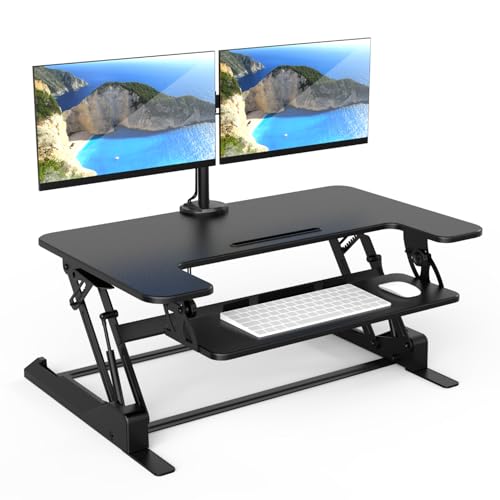
A standing desk L shape setup pairs a height-adjustable main desk with a return or side surface at a right angle, giving you more work area without crowding the room. This guide walks you through deciding whether the layout fits your space, measuring the corner, and setting the heights so you can sit or stand without strain. Most of the work is in the planning, so take your time with the measurements.
Decide Whether an L-Shaped Layout Fits Your Space
An L shape desk standing configuration works best in a room where you have a free corner or a wall you can run the return along. Before buying anything, sketch your room and note where doors, windows and outlets sit, because these limit where the return can go. If your main work is one monitor and a keyboard, a straight desk may be enough. If you use multiple screens, spread out reference material or switch between a laptop and a writing pad, the extra surface usually pays off.
Shopping for one? See our guide: 6 Best Standing Desk for Home Office (2026): Expert Picks.
Measure Your Corner and Your Body
Take these measurements before you shop:
- Measure the wall length on each side of the corner, from the inside corner outward. Subtract about 2 inches for clearance so the desk does not sit tight against the wall.
- Measure the space behind the return where your chair will roll. Leave at least 36 inches of clear floor if you plan to sit at that end.
- Measure your height and your elbow height while seated. Your desktop should land near your elbow when you sit and near your elbow again when you stand, so the surface needs a range that covers both.
- Check the height range of the frame. Many manufacturers list a minimum and maximum height, so confirm both suit your build.
Set Up the Standing and Sitting Heights
Once the desk is in place, adjust the main surface first. Stand with your shoulders relaxed and your forearms parallel to the floor, then set the height so your elbows bend at about 90 degrees. Next, set the return to the same height or slightly lower if you use it for a mouse or notepad. Keep the monitor top at or just below eye level, roughly an arm’s length away. Avoid leaning forward to reach the return, since that shifts strain onto your neck and lower back.
| Element | Target setting |
|---|---|
| Main desk height while standing | Elbows near 90 degrees |
| Return surface height | Same as main desk or slightly lower |
| Monitor top | At or just below eye level |
| Clear floor behind return | At least 36 inches |
Plan Your Cable and Monitor Layout
An L-shaped desk often ends up with more cables than a straight one, so plan the routing early. Run power to the corner with a surge protector mounted under the surface, and use a cable tray along the back edge. Position monitors so you can turn your head rather than your whole body to see each screen. If you use two screens, place the primary one directly in front of the main section and angle the second toward the return.
Common Mistakes to Avoid
- Buying a return that is too deep, which blocks chair movement and makes the far corner hard to reach.
- Setting the return higher than the main desk, which forces shoulder elevation.
- Skipping the clearance measurement, leaving the desk jammed against the wall.
- Placing the monitor too far away, causing you to lean in and strain your neck.
- Ignoring cable routing until after installation, which leads to tangled and exposed wires.
Recommended Gear
A sturdy frame with a reliable height-adjustment motor is the most important piece, since it carries the weight of the whole L shape. A monitor arm lets you raise and angle the screen to match your eye level from either section of the desk. A cable tray or under-desk cable management kit keeps the extra wiring of a corner setup tidy and out of the way.
- Standing desk L-shaped frame with dual motors: a sturdy base is what keeps the corner stable as you raise and lower it. View on Amazon
- Single or dual monitor arm: lets you position screens at eye level without taking up desk space. View on Amazon
- Under-desk cable tray: holds power strips and cords off the floor so the corner stays clear. View on Amazon
If you are also planning movement breaks at your new setup, the Standing Desk Exercise Basics guide covers simple moves you can do without leaving your station. For ideas on keeping your legs active while you work, see Standing Desk Leg Exercises: 7 Moves to Keep Legs Active at Work.
FAQ
Is an L shape desk standing setup harder to fit in a small room?
It can be, because the return takes up floor space along a second wall. Measure the room first and confirm you have clearance for the chair and a walkway. A compact return length often solves the problem.
Do both sections of an L-shaped desk need to adjust in height?
Not always. Many setups use one height-adjustable main surface and a fixed return at the matching height. If you want both sections to move, look for a frame designed for dual surfaces.
What height should the return be when I am standing?
Set it so your elbows bend at about 90 degrees when your forearms rest on the surface. Keep it level with the main desk for the most comfortable transitions between sitting and standing.
Conclusion
A standing desk L shape layout gives you extra surface and flexible workspace when your room has room for a corner. Measure the space and your body carefully, set both sections to comfortable elbow height, and plan your cables before installation. If you have a health condition or specific ergonomic needs, consult a physical therapist or occupational health professional before making changes.
Related reading
Ready to choose one?
About Lauren Holland
Lauren Holland is part of our editorial team and reviews and edits our fitness at work guides, checking product details against manufacturer specifications and owner feedback.