By Owen Palmer
Updated November 2026
Swiss ball desk exercises let you train your core, back and hips without leaving your workspace. Sitting on an inflated stability ball forces small muscles to stay active, which can help you build endurance and sit more upright over the course of a workday. The moves below take about five minutes and need only a clear patch of floor and a chair you can roll away from.
Set Up Your Ball and Workspace Before You Start
A good setup matters more than any single move. Manufacturers of most stability balls recommend choosing a size based on your height, and a common guide is a 55 cm ball for people roughly 5’0″ to 5’5″, 65 cm for about 5’6″ to 5’11”, and 75 cm for taller users. Inflate the ball until it gives slightly when you press on it, but still feels firm. When you sit on it, your knees should sit about level with or slightly below your hips, and your feet should rest flat on the floor.
Shopping for one? See our guide: 6 Best Standing Desk for Home Office (2026): Expert Picks.
Keep your monitor at eye level and your keyboard at elbow height so you are not leaning forward to reach your work. Clear a space of at least a few feet around the ball so you can shift or stand without bumping into anything.
Seven Swiss Ball Desk Exercises to Try
Perform each move slowly, aiming for 8 to 10 controlled repetitions or about 20 to 30 seconds per hold.
- Seated balance hold: Sit tall with feet flat and hands resting on your thighs. Lift one foot an inch off the floor and hold for 15 seconds, then switch.
- Pelvic tilts: Rock your hips forward so your lower back arches slightly, then roll them back so your tailbone tucks under. Move only your pelvis, not your torso.
- Seated side bends: Reach one arm overhead and lean gently to the opposite side, keeping both sit bones planted. Hold for 10 seconds on each side.
- Ball march: Lift one knee toward your chest, then lower it while lifting the other. Keep your torso still and your core braced.
- Seated oblique twist: Hold your hands loosely in front of your chest and rotate your upper body to one side, then the other. Keep your hips facing forward.
- Ball roll-out (small range): Walk your hands forward on the desk edge while your hips stay over the ball, then walk them back. Stop before your lower back starts to sag.
- Standing ball squat: Stand with the ball against a wall at your lower back, then slowly bend your knees and lower your hips about halfway. Return to standing.
Build a 5-Minute Routine You Will Actually Use
You do not need to do all seven moves at once. A simple sequence is to start with the balance hold and pelvic tilts to wake up your posture muscles, move through the side bends and twists, and finish with ball marches. Repeat the routine once or twice a day, or whenever you notice your shoulders rounding or your lower back tightening.
| Time | Moves | Focus |
|---|---|---|
| 0:00–1:30 | Pelvic tilts, balance hold | Posture and hip control |
| 1:30–3:00 | Side bends, oblique twists | Trunk mobility |
| 3:00–5:00 | Ball marches, standing squats | Core and leg endurance |
Common Mistakes to Avoid
- Sitting on a ball that is too soft or too large, which makes balance harder than it needs to be.
- Bouncing or rocking aggressively, which can strain your lower back.
- Holding your breath during balance holds. Breathe steadily throughout each move.
- Letting your knees collapse inward during standing squats.
- Staying on the ball all day. Alternate with your regular chair so you do not overload your back.
Recommended Gear
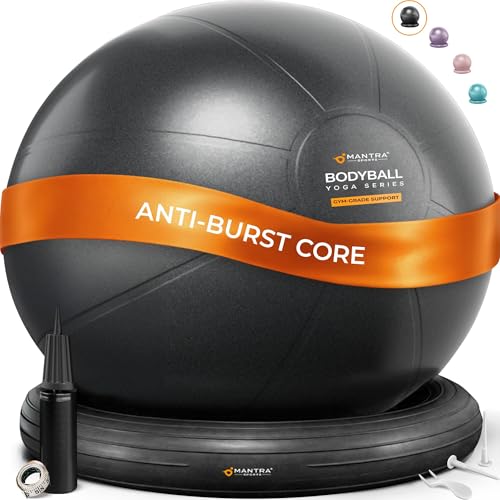
A standard stability ball is the core piece of equipment for these moves. Look for one with an anti-burst rating so a small puncture does not cause a sudden deflation. View on Amazon
A small hand pump makes it easy to adjust firmness as you get used to balancing on the ball. View on Amazon
A wall-mounted or freestanding ball rack keeps the ball out of your walking path when you are not using it. View on Amazon
If you want more variety for your breaks, Stability Ball Desk Exercises: 8 Moves You Can Do at Work covers additional moves, and Ball Exercises While Sitting at Desk: 7 Moves for Core and Posture focuses on core work. For back-focused routines, see Stretching Exercises for Sitting at a Desk: 8 Moves for Stiff Workdays.
FAQ
Can swiss ball desk exercises replace a workout?
No. These moves are useful for short breaks and light activation, but they do not replace structured strength or cardio training. Think of them as a supplement to your regular exercise.
How long should I sit on the ball each day?
Many people start with 20 to 30 minutes in total, split into short sessions, and increase gradually as they get comfortable. If you have back pain, neck pain or balance concerns, consult a healthcare professional or physical therapist before starting.
Is a swiss ball safe for everyone at a desk?
Most adults can use one with a proper size and setup, but people with spinal conditions, recent injuries or pregnancy should check with a doctor first. Stop any move that causes sharp pain.
Conclusion
Swiss ball desk exercises can add gentle core work and better posture to an ordinary workday. Start with the setup, choose two or three moves, and repeat them consistently for a few weeks. Your body will tell you quickly whether the routine fits your needs.
Related reading
- Yoga Ball Desk Exercises: 9 Moves for Core and Posture at Work
- Exercise Ball Desk Exercises: 8 Moves for Your Chair Setup
- Yoga at Desk Exercises: 10 Seated and Standing Moves for Work
- Workplace Printable Desk Exercises: 8 Moves to Print and Keep at Your Desk
- Workplace Exercises at Your Desk: 7 Moves for a 5-Minute Break
Ready to choose one?
About Owen Palmer
Owen Palmer is part of our editorial team and reviews and edits our fitness at work guides, checking product details against manufacturer specifications and owner feedback.